

AMSA 2026 Conference
Dates:
June 25th-27th 2026
Theme:
Masculinities, Care, and Community: Grounded in Care, Powered by Community, Inspired by Joy


AMSA 2026 Conference Theme
AMSA 2026 Conference Submission
Masculinities, Care, and Community: Grounded in Care, Powered by Community, Inspired by Joy
Annual Meeting of the American Men’s Studies Association (AMSA)
June 25-27th, 2026 | Cleveland, Ohio
This is an in person conference. The American Men’s Studies Association embraces place-based scholarship as a core value, emphasizing the importance of engaging local histories, communities, and social conditions in the production of knowledge. In alignment with the 2026 conference theme, Masculinities, Care, and Community, AMSA is intentionally hosting the conference as an in-person event in Cleveland, where care, activism, and community resilience are actively practiced and negotiated. Gathering face to face allows for deeper intellectual exchange and affirms our commitment to scholarship that is grounded, relational, and rooted in place.
As global divisions deepen, care and connection emerge as both urgent and undervalued social practices. Masculinities studies, long preoccupied with men’s entanglements in violence, control, and toxicity, offers a crucial site for rethinking how men relate to care as givers, receivers, and resisters. Re-examining masculinities through the lens of care and communities opens new ways of understanding power, emotion, and responsibility in contemporary life.
This year, AMSA invites participants to imagine gendered power, relationality, and resistance in new ways by asking how masculinities might be reconfigured through practices of care, towards the self, others, and community, and how these practices challenge or reinforce enduring hierarchies of gender, race, class, and ability. We also want to understand how we might bridge academic and theoretical advancements with real world activism and community resistance.
We seek papers, panels, workshops, and creative projects that explore how masculinities are enacted, resisted, and transformed across diverse contexts. We especially welcome work that bridges theory, praxis, and activism, foregrounding the everyday practices of mutuality and joy that make new forms of community possible. Possible areas of engagement include (but are not limited to):
-
Care work, kinship, and relational ethics;
-
Surpassing ideas of “toxic” masculinity to realize new forms of masculinities;
-
Healing justice, mutual aid, and community resilience;
-
Masculinities and emotions, such as joy, grief, and pleasure;
-
Race, coloniality, and the politics of care;
-
Digital masculinities, online communities, and creative resistance;
-
Technological transformations of masculinities, including algorithmic representation, digital embodiment, and AI-mediated performances of gender;
-
Pedagogies and methodologies of care;
-
Activism, art, and place-based practice;
-
Intersectional understandings of masculinities;
-
We also welcome papers, panels, workshops, and creative projects that connect to masculinities more broadly.
-
If you would like to submit multiple proposals, please fill in a separate form for each one.
Centrally located and cost-effective, grounding the 2026 conference in Cleveland, Ohio enables broad participation from scholars, activists, and students across the world. The conference site sits in University Circle, one of the most culturally dense square miles in the country, and home to the Cleveland Museum of Art, MOCA, the Cleveland Botanical Garden, and the vibrant Little Italy neighborhood. Often overlooked due to histories of racism, segregation, and deindustrialization, Cleveland is now experiencing a vibrant cultural resurgence led by artists, activists, and grassroots organizers. Hosting AMSA 2026 here affirms our commitment to place-based scholarship and to the political importance of engaging with overlooked urban spaces.
QUESTIONS? CONTACT US AT CONFERENCEAMSA@GMAIL.COM
Please note: We will not be able to offer re


Where culture, care, and community come together
Cleveland is a welcoming mid-sized city known for its cultural richness, creative energy, and strong traditions of community life. Shaped by industry, immigration, and social movements, the city has long been a site of cultural production, civic engagement, and collective care. Today, Cleveland offers the depth and diversity of a major cultural center at a scale that remains accessible, affordable, and walkable.
The city is nationally recognized for its arts and cultural institutions, including a world-class orchestra, a vibrant theater scene, and a robust network of museums, libraries, and public spaces. Food, music, and neighborhood life play a central role in Cleveland’s social fabric, reflecting both its historical roots and its contemporary creativity.
AMSA 2026 is hosted at Case Western Reserve University, located in University Circle, one of the most concentrated cultural districts in the United States. This area exemplifies Cleveland’s distinctive density, where academic institutions, cultural organizations, healthcare systems, and community spaces intersect within a shared urban environment. The result is a setting that encourages movement between intellectual exchange and lived experience.
Cleveland’s identity is grounded in connection. Its neighborhoods, public institutions, and natural landscapes reflect long-standing commitments to care, resilience, and collaboration. For conference participants, the city offers more than a backdrop. It provides a social and cultural context that aligns closely with the conference’s emphasis on place, community, and relational scholarship.

Places to Explore
Cleveland offers an unusually dense mix of culture, history, science, and public space, much of it located just minutes from the conference site. The places highlighted here reflect the range of experiences available to attendees throughout the conference weekend.
In University Circle, participants are steps away from the Cleveland Museum of Art, the Cleveland Museum of Natural History, the Cleveland Botanical Garden, the Cleveland History Center, and the Dittrick Medical History Center, which offers a critical lens on the social history of medicine and public health. Together, these institutions invite exploration that extends conference conversations into questions of culture, science, care, and social change.
Beyond campus, Cleveland’s cultural life continues downtown at Playhouse Square, the nation’s largest performing arts district outside of New York City, and along the Lake Erie waterfront at the Rock & Roll Hall of Fame and the Great Lakes Science Center, both located at North Coast Harbor.
For those looking to explore the city’s neighborhood life, areas such as Gordon Square, Tremont, Little Italy, Ohio City, and downtown offer walkable streets, local restaurants, galleries, and spaces for informal gathering.
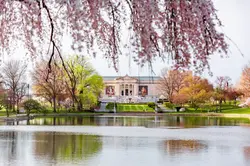
Across the city, neighborhoods, parks, and public spaces offer opportunities to gather, reflect, and connect. From the gardens and walkable streets of University Circle to Lake Erie’s shoreline and the broader Cleveland Metroparks system, Cleveland makes it easy to move between intellectual exchange and shared experience during the conference.
 |  |
|---|---|
 |  |
 |  |
Click through the Cleveland polaroids!
Click the pictures to learn more!

Rock and Roll
Hall of Fame

Cleveland Museum of Natural History

Cleveland Museum of Art

Playhouse Square

Cleveland Botanical Gardens


Transportation & Accommodations
Cleveland is an easy and accessible city for conference travel. Cleveland Hopkins International Airport offers direct flights from many major U.S. cities, and public transportation provides a straightforward connection from the airport to University Circle via the RTA Red Line. Local buses and the HealthLine bus rapid transit run frequently along Euclid Avenue, and the free CircleLink shuttle connects key sites throughout campus and the surrounding area. Ride-share services and taxis are also widely available.
Conference accommodations are centered within walking distance of the venue. We recommend the Glidden House, a historic boutique hotel located directly in University Circle, and the Courtyard by Marriott Cleveland University Circle, both of which offer comfortable lodging, easy access to conference spaces, and proximity to museums, restaurants, and public transit. Their location allows attendees to move easily between sessions, cultural sites, and neighborhood amenities without needing a car.